What is brand equity?
You want to build your brand’s equity model. But a quick survey of the models for doing so reveals a plethora of options. We’ve found most of these models are either too complex for practical use or are more retrospective tools rather than forward planning tools.
We have developed a consumer-based brand equity model that, by comparison, is easy to understand and use for planning and assessing marketing activities.
What is brand equity in marketing? This model is not based on financial valuation or product attributes. It’s based on the conditions that must be satisfied to increase the probability of future purchases by a defined group of consumers.
To define brand equity, it’s important to mention that this model, prospects enter the cycle on top, work around the cycle and then, hopefully, are retained by the brand in the advocacy loop. The idea is for marketing to keep prospects and customers circulating and retain as many people as possible in the advocacy loop. A description of each phase is presented below.
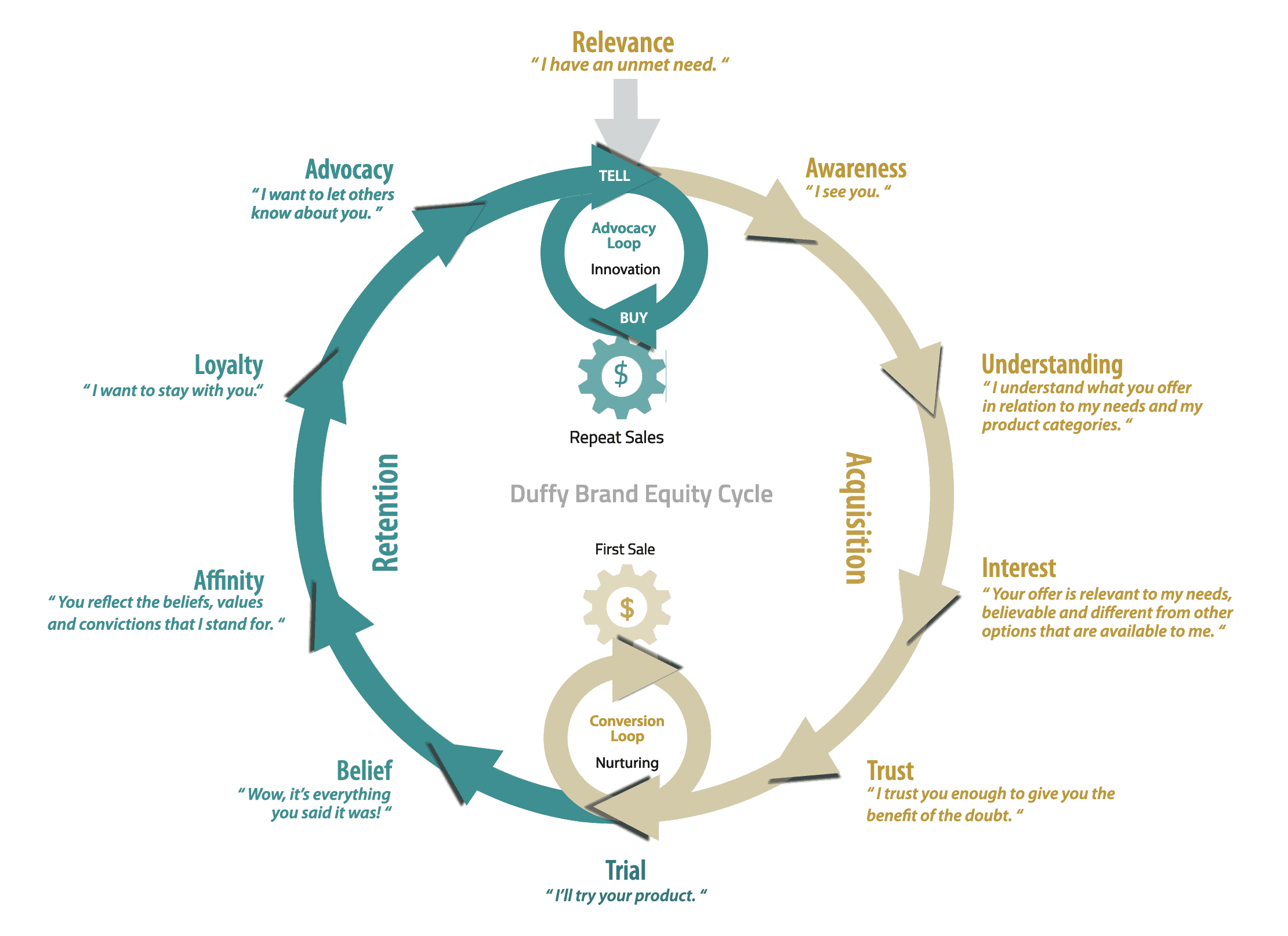
Duffy Brand Equity Cycle modeled from the customer’s perspective
Inertia
The prospect has a relevant want or need but is not aware of the brand.
Example — “I want my little Jimmy to draw, but my problem is that he scribbles all over the walls and I have no idea how to deal with that.”
Awareness
The prospect is exposed to the brand and it registers with them.
Example — “I saw the Wipe Away logo, but I don’t know what it is. Something to do with kids I think.”
Understanding
The prospect understands what category of product the brand stands for.
Example — “I get it, Wipe Aways is a children’s crayon brand. But I already buy Crayola for little Jimmy.”
Interest
The prospect is able to differentiate your brand from others in the category based on a value proposition that is relevant and believable to them at that moment.
Example — “Interesting: Wipe Away crayons are water-soluble so they wash off easy, especially from walls”.
Trust
The prospect trusts the brand enough to give it the benefit of the doubt.
Example — “I was wondering if they were safe and worked well, but then I read some positive reviews on a Mommy Blog and saw that my friend Sally recommended them on Facebook. Wipe Aways are probably okay.”
Trial
The prospect purchases the product.
Example — “They’re at Walmart and cost about the same as normal crayons, so I’m going to buy a pack for little Jimmy.”
Belief
Based on their experience with the product, the prospect concludes that the brand delivered on its value proposition.
Example — “Wow, Wipe Aways really work as promised! They wiped right off the wall.”
Affinity
The prospect is receptive to looking for reasons to like the brand and concludes that the brand shares many of their beliefs, values, and convictions.
Example — “This brand really gets me. They are into education, child safety, and the arts just like me. We have a lot in common.”
Loyalty
The prospect becomes a customer and stops actively looking for other solutions because they are satisfied that the brand delivers the best value in the category.
Example — “From now on, these are the crayons for me.”
Advocacy
The customer wants to be associated with the brand and is prone to tell others about the brand.
Example — “I’m posting little Jimmy’s wall drawings on Wipe Away’s gallery site and sharing them with my friends on Twitter and Facebook.”
A clear division between sales and marketing
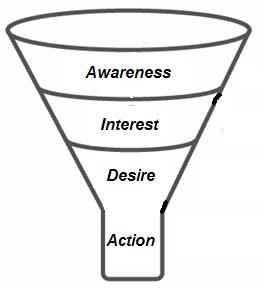 The brand equity model is intended to replace classic sales-funnel “AIDA” thinking. The sales funnel is a finite business process that takes the consumer in at the top and spits them out at the bottom. The fact that the sales funnel process terminates in a sale is one of the main reasons it is no longer is suitable. Strategic marketing today requires a far more nuanced view of the journey a consumer takes both before the sale leading up to trial, as well as after the sale leading up to repurchase and advocacy.
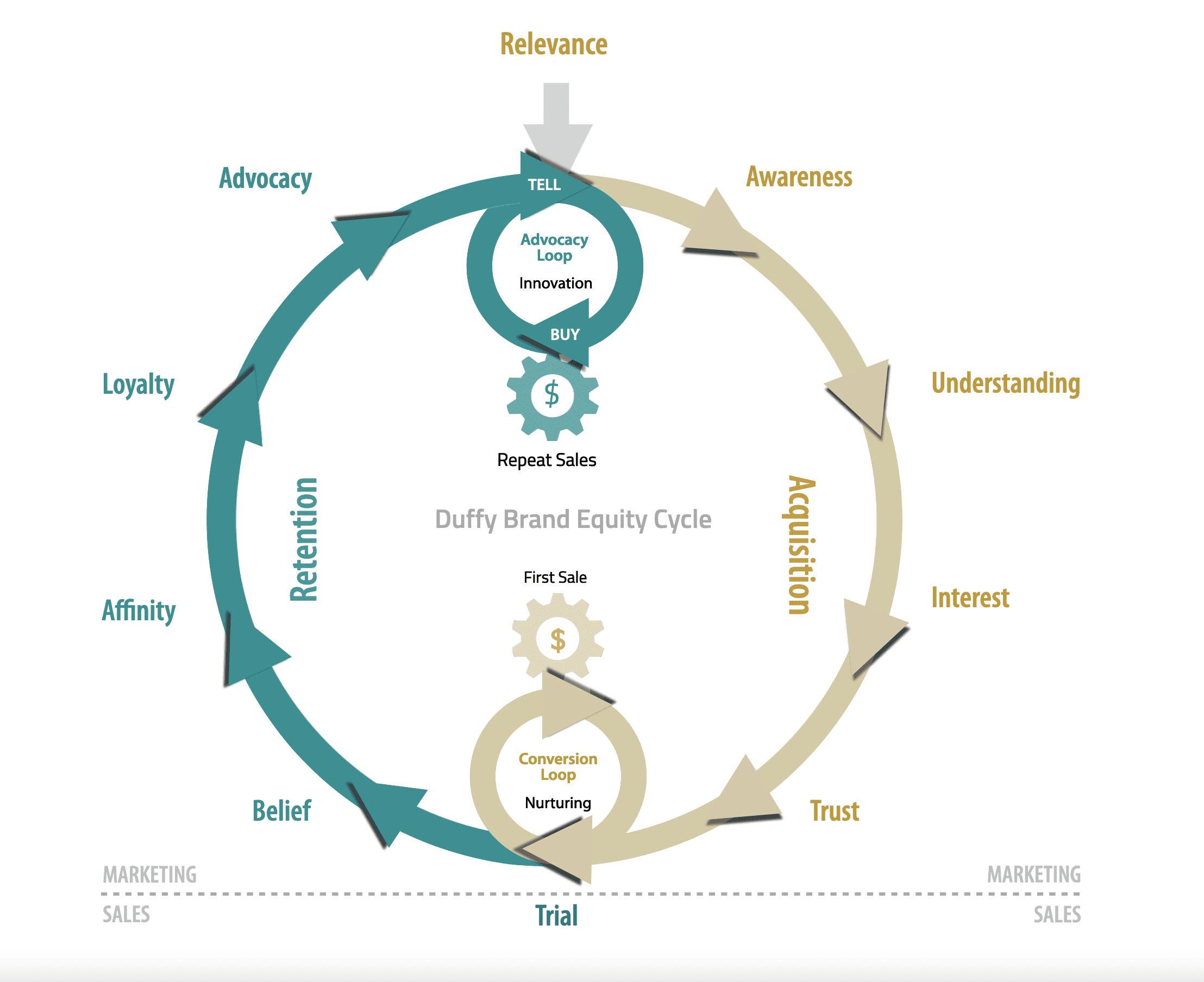
This model also addresses the rift that often exists between sales and marketing staff, and their approach to communication. The traditional “ABC” (Always Be Closing) approach to sales communication may work wonders when closing a sale in the Trial phase of this model. But, as anyone experienced in content or social media marketing knows, for most premium brands this approach will kill credibility in every other step of the process. Conversely, if marketing-style communication is used in the sales phase you would never close anything.
In the Duffy Brand Equity Cycle, we define “Trial” and “Buy” in the Advocacy Loop, as the sales phases where leads are converted/closed. The other eight steps are marketing phases where those leads are generated and nurtured, both leading up to the sale as well as after, leading to repeat purchase and recommendation. This creates a clear division between the roles of sales (closing leads) and marketing (generating, nurturing and retaining leads) which dictates the approach taken.
With this model, brand equity meaning is defined as the degree to which a brand has achieved consumer awareness, understanding, interest, trust, trial, belief, affinity, loyalty, and advocacy among a defined target group. The cycle is intended to illustrate the nine ways that consumers create brand equity for companies over time, as they transition from inertia to advocacy. The activity of “branding” is simply to facilitate the consumer’s journey from inertia to advocacy while maximizing the effectiveness of each step along the way. All marketing activities should directly contribute to one of these steps (consumer awareness, consumer understanding, consumer interest, etc…) in a manner that will not hinder progress further along the cycle. This model may not conform to everyone’s brand equity definition. But, until a unified definition exists, we have found these steps provide a structured approach to building international brands in a measurable, defendable, and profitable manner.A consumer-centric brand equity definition